Cats and Owners Show Matching Oxytocin Patterns, Japanese Study Finds
Researchers at Kyoto University tracked 19 owners and 29 cats for a month and found that owners' and cats' oxytocin levels were linked, and that closeness at home mattered more than years together.
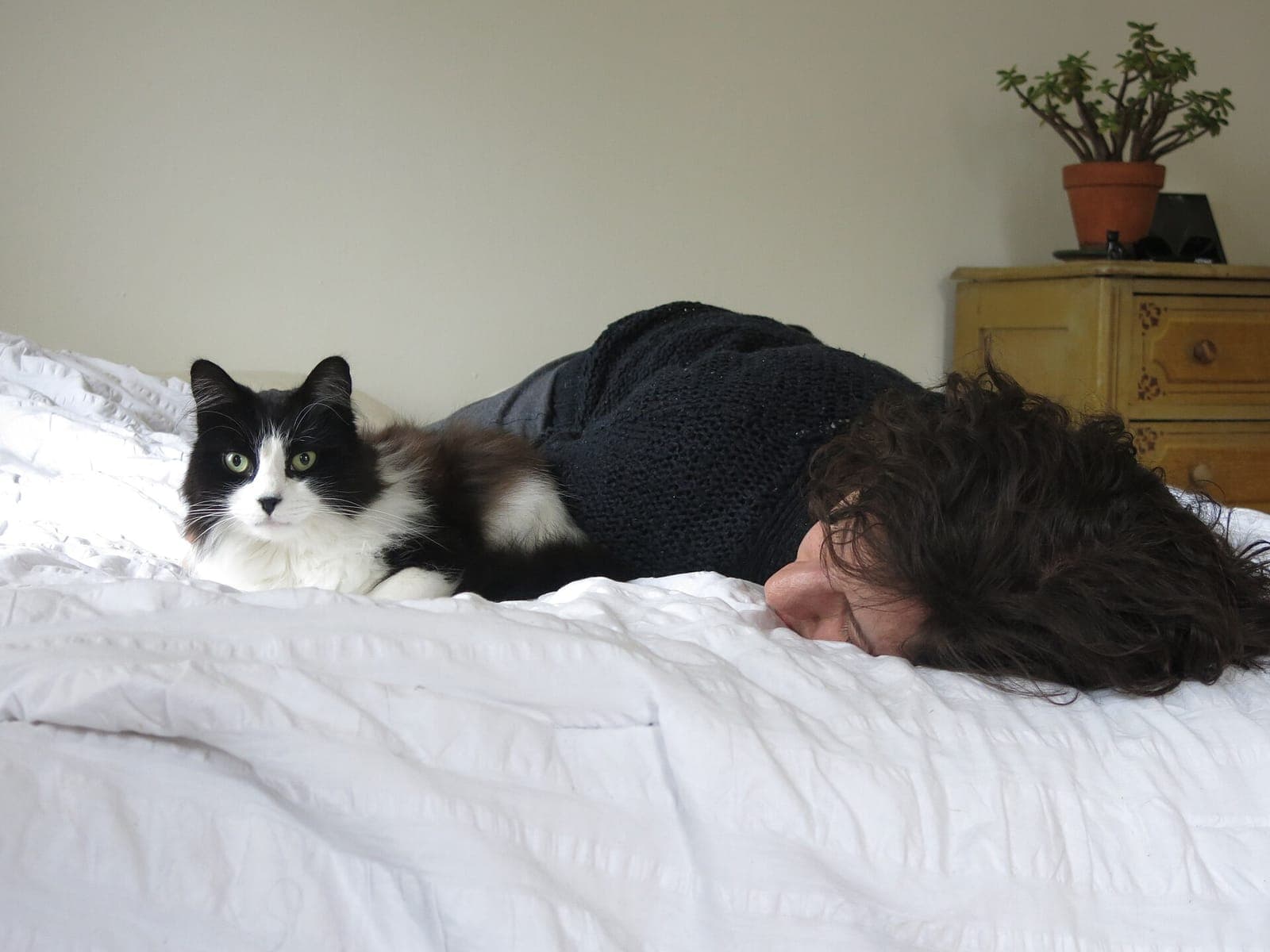
A black-and-white cat sits beside a person resting on a bed. File photo, not from the Kyoto study.
Photo: Testtotest, CC BY-SA 4.0, via Wikimedia Commons
Cats and their owners have linked levels of the bonding hormone oxytocin, and owners whose cats spend more time near them report feeling more energetic, according to a study from Japan. The research was led by Saho Takagi of Kyoto University's Hakubi Center together with Takefumi Kikusui of Azabu University, and it was published online in the journal iScience on October 14, 2026. Kyoto University released a summary two days later, and the findings drew wider coverage in late October and early November.
The team set out to answer a question that years of cat ownership research have left open. Some studies have found that living with a cat is good for an owner's mental health, while others have found little benefit or even a link to worse mental health. Rather than ask whether owning a cat helps, the Kyoto researchers asked whether the quality of the relationship, and how owners and cats actually spend their days, makes the difference.
Who took part and what was measured
Participants were recruited through flyers and social media. They were 19 owners aged 18 to 60, 16 of them women and 3 of them men, and their 29 cats, which ranged from 4 months to 13 years old. Over one month, each household took part in four kinds of measurement.
Hormones: owners and cats each provided urine samples three times, which were tested for oxytocin, a hormone tied to social bonding, and cortisol, a stress hormone. Five cats could not provide urine, so the hormone analysis covers 24 cats and 17 of the owners.
Distance: a small Bluetooth Low Energy beacon on each cat's collar sent signals to the owner's smartphone throughout the month. Signal strength was used as a measure of how close the cat stayed to its owner while the owner was at home.
Mood: owners completed a standard mood questionnaire.
Behavior: the researchers adapted a secure base test to watch how each cat approached its owner and an unfamiliar person.
What they found
Owners' and cats' oxytocin levels were positively associated: owners with higher oxytocin tended to live with cats that also had higher oxytocin. In the paper's statistical model the association had a coefficient of 0.55, with a 95 percent confidence interval running from 0.17 to 0.91.
More cat news
- Most Older Cats Develop Several Age-Related Conditions, Long-Running UK Study Finds
- Nepal Tests Lab-Made Scent Markers to Keep Tigers and Leopards Away From Livestock
- Scientists Name Leopardus tilcayo, the First New Wild Cat Species in More Than a Century
- Kazakhstan Releases a Tiger in Bid to Restore the Caspian Tiger's Lost Range
Comments (0)
Join the conversation
Sign up to share your thoughts.
Loading comments...