
Kazakhstan Releases a Tiger in Bid to Restore the Caspian Tiger's Lost Range
A female named Umit, flown in from the Russian Far East, was released on July 31 as the first step toward a population of about 50 tigers.
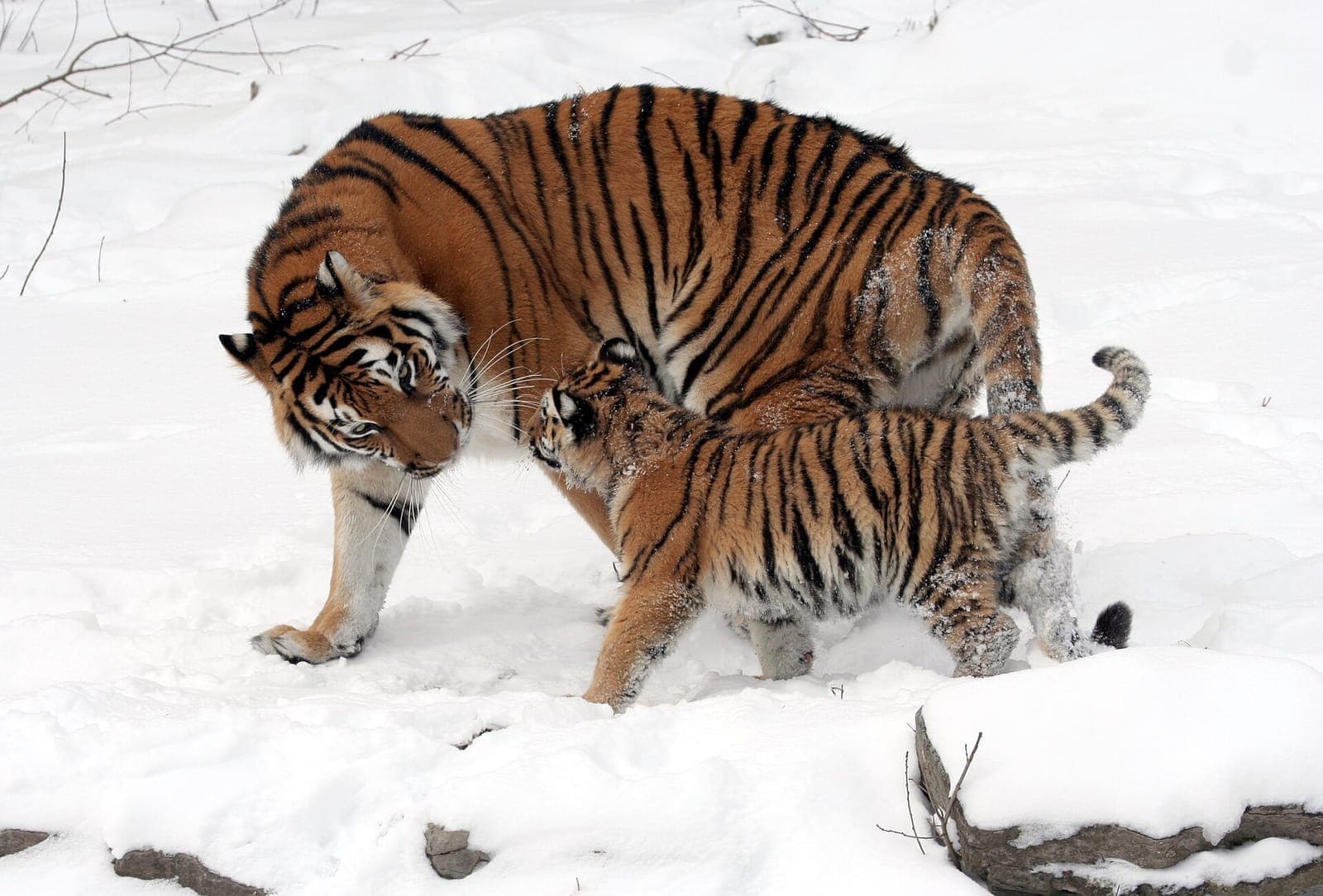
An Amur tiger and her cub in the snow at Buffalo Zoo in the United States. File photo, not from the Kazakhstan release.
Photo: Dave Pape, public domain, via Wikimedia Commons
Kazakhstan has released a tiger into the wild for the first time in more than 70 years, the first step in a plan to bring back a big cat that vanished from Central Asia. The female, named Umit, which means hope in Kazakh, was freed on July 31, 2026 in the Ile-Balkhash nature reserve on the edge of Lake Balkhash, after more than a decade of planning. The Guardian reported the story on August 11, 2026, and Euronews covered it on August 5.
Who Umit is and where she came from
Umit is an Amur tiger, a wild animal captured in the Russian Far East. She was one of four Amur tigers of different sexes and ages delivered from Khabarovsk to Kazakhstan in May 2026 under a joint program run by the two countries' conservation agencies, with the support of the Amur Tiger Center. The handover took place at the Eurasian Economic Forum, in the presence of the presidents of Russia and Kazakhstan, according to the Russian Ministry of Justice, which said the Russian justice minister, Konstantin Chuychenko, attended the release.
The other three tigers are still being prepared. An adult male is under observation and will be released once experts judge him ready to survive alone. Two cubs that arrived at six months old are being raised in enclosures with as little human contact as possible and will stay in the care of wildlife experts until they are 18 months old, which the Guardian said means a likely release next year. Two other tigers, named Kuma and Bohdana, were brought to the reserve from the Netherlands in September 2024, Euronews reported.
How she was prepared
The program has two stages. First the tigers live in a large enclosed area to adapt to the local environment, and then they are released into the reserve, which is protected but not fenced. Umit spent two months under close observation before release while experts assessed her health, behavior and hunting skills. According to the Russian side, the tigers avoided people, noticing a person about 150 meters from the enclosure and moving away without showing curiosity or aggression, and they passed hunting tests.
Umit was fitted with a GPS and satellite tracking collar. Authorities say nearby residents will be alerted if a tiger comes within five kilometers of a village, and the environment ministry said a dedicated team will respond if an animal approaches a populated area.
More cat news
- Cats and Owners Show Matching Oxytocin Patterns, Japanese Study Finds
- Most Older Cats Develop Several Age-Related Conditions, Long-Running UK Study Finds
- Nepal Tests Lab-Made Scent Markers to Keep Tigers and Leopards Away From Livestock
- Scientists Name Leopardus tilcayo, the First New Wild Cat Species in More Than a Century
Comments (0)
Join the conversation
Sign up to share your thoughts.
Loading comments...