
The Cat Lovers logoThe Cat Lovers
Search anything
The Cat Lovers logoThe Cat Lovers
Search anything
HomeCatopiaForumNewsGamesQuizzes
ArticlesBehaviorHealthNutritionView all
Pull to refresh
The Cat Lovers

A free, friendly community for cat people: questions, photos, care guides, games and a virtual cat of your own.

Explore

  • Home
  • Catopia
  • Forum
  • News
  • Games
  • Quizzes
  • Members

Articles

  • Behavior
  • Health
  • Nutrition
  • View all

The Cat Lovers v6.5.1

  • Privacy Policy
  • Terms of Service

Designed by Ctrl Shift Run

Home/News
Newstigersconservationwildlife

Nepal Tests Lab-Made Scent Markers to Keep Tigers and Leopards Away From Livestock

Early camera-trap results are mixed, and the researchers say it is too soon to claim the method protects animals from attacks.
By itsnickbakerPublished November 2, 2026, 1:15 PM UTCUpdated November 2, 2026, 2:23 PM UTC5 min read
SourceMongabay
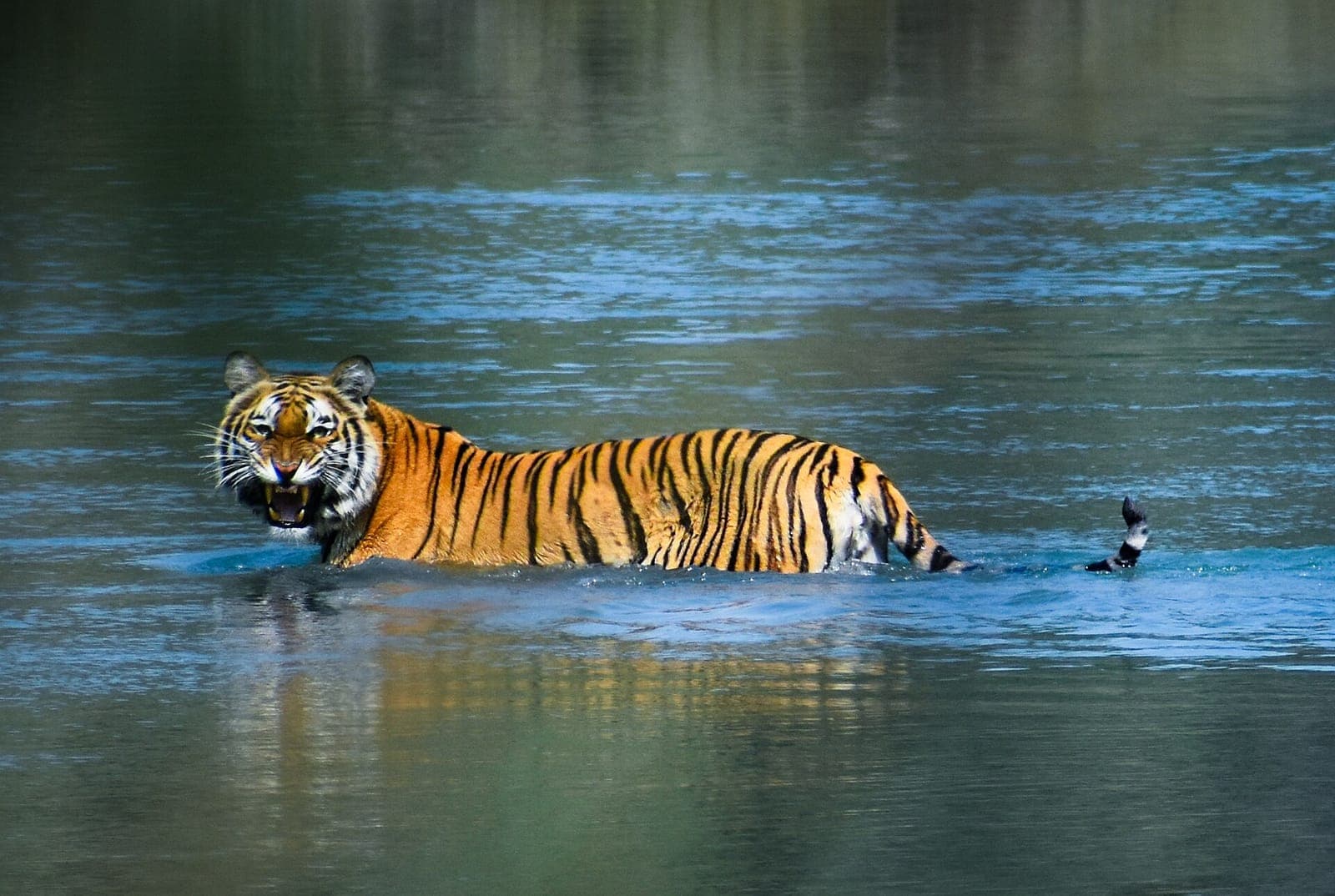
A Bengal tiger in Bardiya National Park, Nepal. File photo, not from the scent-marker trial.

A Bengal tiger in Bardiya National Park, Nepal. File photo, not from the scent-marker trial.

Photo: Nirojsedhai, CC BY-SA 4.0, via Wikimedia Commons

In March 2025, a Bengal tiger walking a forest trail in Nepal's Khata Corridor stopped at a small iron stake beside the path. Attached to it was a dispenser releasing a laboratory-made version of a chemical found in the scent marks big cats use to claim territory. A camera trap recorded the tiger sniffing the odor and then turning back. It was one of several encounters in an experiment that Mongabay reported on October 30, 2026, which asks whether artificial scent can keep tigers and leopards away from livestock and villages.

The researchers call the idea BioBoundaries, an invisible border made of smell. The early results are mixed, and the scientists involved are careful about what they claim.

The problem it is meant to solve

Communities in Nepal's buffer zones live alongside tigers, leopards and, at high elevations, snow leopards. They protect livestock and homes with electric fences, flashing lights and sirens, but large carnivores can learn that lights and noise are harmless, and fences are expensive to build and maintain. Livestock are most at risk when they graze in forest or are kept in weak sheds.

How the trial works

The project is a three-year effort by Cornell University, WWF Nepal and forest authorities in Bardiya National Park and the Dolpa district in western Nepal, supported by about a dozen field staff. In October 2024 the team began testing 10 synthetic compounds at treated and control stations in the Khata Corridor, a 13 kilometer (8 mile) stretch of land linking Bardia National Park with India's Katarniaghat Wildlife Sanctuary. Most of the compounds had originally been identified in tiger scent.

A second phase from December 2025 to June 2026 narrowed the list to six compounds, although it was delayed by Nepal's national tiger census, which took up field staff. The team installed 30 stations, each with an iron stake, a scent dispenser and a camera trap. The chemicals are released at rates measured in millionths of a gram per hour, and local citizen scientists help check the stations and collect footage. Dispensers are left empty during control periods and the equipment goes in weeks before testing begins, so that researchers can tell reactions to the chemical from curiosity about an unfamiliar object.

Share this article

More cat news

  • Cats and Owners Show Matching Oxytocin Patterns, Japanese Study FindsNov 2, 2026
  • Most Older Cats Develop Several Age-Related Conditions, Long-Running UK Study FindsNov 2, 2026
  • Scientists Name Leopardus tilcayo, the First New Wild Cat Species in More Than a CenturyNov 2, 2026
  • Kazakhstan Releases a Tiger in Bid to Restore the Caspian Tiger's Lost RangeNov 2, 2026
All cat news

Comments (0)

Join the conversation

Sign up to share your thoughts.

Log inSign up

Loading comments...

What the cameras recorded

Results varied by compound, species and site. Three of the compounds were linked to fewer leopard detections and two to fewer tiger detections. Tigers sniffed some of the stations intensely and showed flehmen, the lip-curling behavior cats use to investigate chemical signals, and some turned back after sniffing. Other compounds did the opposite.

Other compounds produced the opposite response: Instead of turning away, the tigers became more interested and visited the site more frequently. That was not the intended outcome.

That is how Shashank Poudel, head of the wildlife program at WWF Nepal, described it to Mongabay. Poudel said another compound looked more promising as a leopard deterrent. Some scents also made wild boar, spotted deer and sambar flee, which raises an untested possibility that they could help protect crops from herbivores.

Where the idea came from

The concept dates to the mid-1990s in Botswana, when wildlife biologist Tico McNutt proposed using long-lasting scent marks to keep African wild dogs from leaving protected areas. Chemical engineer Peter Apps, now a senior researcher with Botswana Predator Conservation, later developed scent deterrents after camera-trap footage in 2016 showed a leopard making a U-turn when it met a component of leopard urine. Apps used gas chromatography and mass spectrometry to identify the chemicals and then tested commercially available versions on wild carnivores.

In Botswana, Apps said, one compound known as 3M3MB substantially reduced leopard attacks on livestock, and African trials have shown little habituation after months of exposure, including one flock reportedly protected for three years. Collar-mounted dispensers have reduced predation there. Those results have not yet been replicated in Nepal, and only 3M3MB had previously been tested in Botswana, so the Nepal work is not a repeat of the earlier leopard trials. One compound that reduced leopard detections in Nepal later produced a similar effect in Botswana.

Why researchers are cautious

Martin Gilbert, a wildlife veterinarian and epidemiologist at Cornell who helped bring the research to Nepal, said a tiger turning away from a station is not proof that the method prevents livestock attacks, and that the team does not claim otherwise. At this stage, he said, the question is whether the compounds can reliably change a predator's behavior.

  • Territory is not the same as exclusion. Babu Ram Lamichhane of Wild Care Nepal, who is not involved in the trial, said census data have recorded up to seven tigers at the same location, although they can use it at different times.

  • Predators may shift elsewhere. Discouraging a predator from one household could redirect it to another corral, so future trials would need to cover areas large enough to show that conflict is reduced and not just moved.

  • Animals could get used to a scent. Apps and Gilbert say habituation may be less likely because the compounds mimic a natural communication system, but long-term effectiveness still needs testing. The team hopes to find several compounds that can be rotated or combined.

  • Weather and placement matter. Lamichhane said rain and moisture could change how the scent disperses, and results would depend on where dispensers are placed and how closely they are spaced.

What could come next

If the scents prove effective, dispensers could be placed around corrals and settlements, or worn on collars by grazing livestock, though collar dispensers have not been tested in Nepal. Gilbert was clear that the scents are meant to add to good livestock husbandry and not replace it.

BioBoundaries aren't intended to replace good livestock husbandry.

Poudel said the team wants more than one working compound so they can be used in rotation. Many practical questions remain open, including how often dispensers need refilling, what they would cost and who would manufacture, approve and distribute them. Poudel suggested veterinary services might one day distribute the compounds, but Gilbert said designing such a system would be premature before researchers show both repeatable avoidance and fewer livestock attacks.

Hari Gurung, chair of the Khata Community Forest Coordination Committee, which represents 39 community forests, told Mongabay that locals already use early warning sirens, watchtowers and wire fencing. He said artificial scent could deter leopards, though he was not sure it would work on tigers, and that if results are positive it could become one of several measures to reduce conflict between people and wildlife.

This report is based on Mongabay's October 30, 2026 article by Deepak Adhikari, which includes interviews with the researchers named above.