Why Do Cats Bring You Dead Animals? What It Really Means
Gifts, lessons or leftovers: what the research says and how to cut down on it

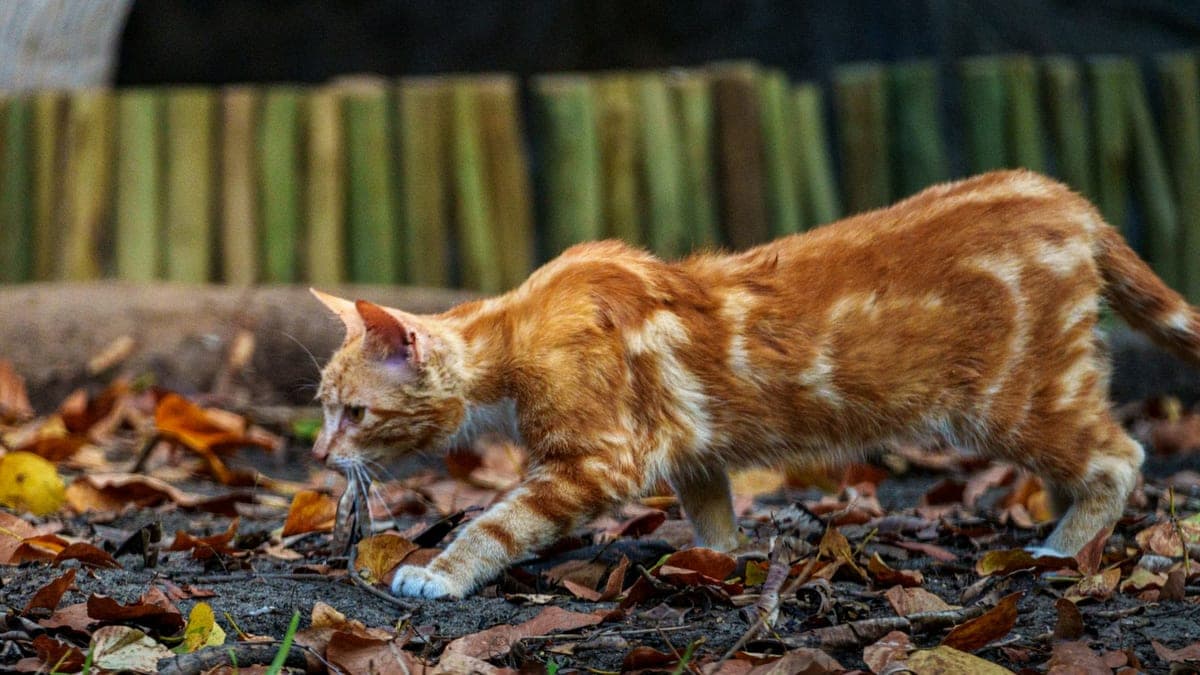
You open the front door to leave for work and there it is: a very small, very dead mouse, lined up neatly on the mat. Or you wake up to a bird on the bedroom floor, and your cat sitting nearby looking pleased with itself. It is hard not to feel like you are being handed something. A present. A message. Possibly a threat.
People have been trying to explain this for as long as people have kept cats, and the truth is a lot more interesting than "it is a gift." This guide looks at the leading explanations for why cats bring home prey, what the research says, what to do when it happens, and what actually reduces it.
The short answer
Cats bring home prey because they are hunters, and the hunting drive does not switch off when the food bowl is full. Why the prey ends up at your door is less settled. The leading ideas are that your cat is treating you like a kitten that needs to be fed and taught, that it feels safer eating or storing food at home, or that you just happened to be near where it settled with the catch. None of this means your cat is angry with you, or that you are underfeeding it.
Cats are hunters first, pets second
International Cat Care explains that the domestic cat is a predatory species. Cats were kept mostly to control rodents until quite recently, and only the best hunters survived and reproduced, so today's pet cats descend from the most skilled ones. There has been very little selective breeding of cats, and the drive to hunt remains strong. Cats are also obligate carnivores, which means they must eat meat. Because they hunt alone and their prey is small, the group notes, a cat has to make several kills a day to meet its energy needs, and with no food from a caregiver a cat can make as many as 10 to 20 kills every day.
That is why a well-fed cat still hunts. International Cat Care says the motivation to hunt is only partly related to hunger. A hunter that waited until it was hungry to start could starve, given how hard it is to catch small prey, so the urge to chase and kill runs separately from the urge to eat.
Research backs this up. WikiVet summarizes a 1976 study by Adamec in which cats stopped eating from a food bowl to catch and kill a live rat, then dragged the carcass back near the bowl and returned to their meal, showing almost no interest in eating the rat. The conclusion is that predatory behavior is triggered by the smell, size and movement of prey, not by hunger. Hunger does change some things, though. WikiVet notes that hungry cats go after larger and riskier prey and kill faster, while satiated cats play with prey for longer.
Cornell's Feline Health Center makes a similar point: predation was one of the traits that made cats desirable companions in the first place, since a good mouser protected grain and food stores from rodents.
Why bring it to you?
Here is where scientists admit they are still guessing. Live Science, talking to experts in 2025, lays out the main theories. None of them has been proven.
Theory 1: You are a very large, not-very-good kitten
The leading hypothesis is maternal. In the wild, mother cats hunt and bring prey back for their kittens. That feeds the kittens, and it also gives them something to play with, practice on, and learn to recognize as prey. Emmanuelle Baudry, an urban ecologist at Paris-Saclay University, told Live Science that in this view our cats may see us as "not so efficient kittens." Your cat is taking care of you, and trying to teach you.
That also explains why some cats bring prey in alive. Cats that release a live mouse in the living room may be doing what a mother cat does when she gives her kittens a chance to practice.
Theory 2: Home is the safest place to eat
Another idea is that cats feel safer eating their catch at home than outdoors. Dr. Stephanie Liff, a veterinarian in New York, told Live Science that cats may see the home as a place of refuge, where they can eat in peace or stash a catch. In that view, you are not the audience. You just happen to live in the dining room.
Theory 3: It really is for you
A 2023 article republished by Phys.org points out that you should first ask whether your cat is actually bringing the prey to you, or whether you simply happen to be where it settled. But if the cat walks toward you holding the prey, makes eye contact and gives a distinctive cry, the author says it is probably intentionally sharing. That is rare, though, and the article notes that cats' meows are mostly designed to get a person's attention.
Dr. Liff takes the generous view: "It's somewhat of a compliment," she told Live Science. "They feel comfortable in their home. They consider you part of their family."
Theory 4: It was already dead
The same Phys.org piece reminds us that sometimes a cat has simply found something that was already dead, whether dropped by an owl, hit by a car, or washed up. Cats are opportunists, and a free meal is a free meal.
What cats actually catch
WikiVet reports that cats usually catch prey around 1 percent of their body weight, and that in one study 80 percent of the reported prey weighed less than 50 grams. In an observational study at a suburban nature preserve in New York, small mammals made up 52 percent of kills and birds 23 percent, and the cats' overall success rate was only 13 percent. In other words, cats fail a lot, and they keep trying anyway.
Cats also hunt insects. WikiVet notes that spiders in particular are rich in taurine, an amino acid cats need. If you have ever found a half-dead cricket in your shoe, your cat was probably just having fun.
Indoor cats do it too
Even cats that never go outside bring things to their people. They carry toys, socks and little stuffed mice, often yowling as they walk through the house. Many behaviorists see this as the same instinct at a smaller scale. If your indoor cat drops a toy at your feet and cries, it is probably a hunting ritual, and an invitation to play.
What to do when you find a dead animal
Stay calm and do not punish your cat. It is following instinct, and a cat cannot connect punishment with something it did hours ago. Punishing makes cats wary of you.
Try not to make a big scene. Dramatic reactions, positive or negative, can be rewarding to a cat. A quiet thank-you in your head is fine.
Clean up safely. Wear gloves or use a bag over your hand, double-bag the body, and put it in the trash. Wash your hands and disinfect the area, because wild animals can carry parasites and germs.
Check your cat. Look for bite wounds, scratches or anything unusual after a hunt, especially if it caught something larger than a mouse.
If the animal is alive and injured, keep your cat away and call a local wildlife rehabilitator. Do not try to nurse it yourself.
Tell your vet if rodent poison is used nearby. A cat that eats poisoned prey can be harmed too.
Can you stop it?
You cannot take the hunter out of the cat, but you can reduce how much your cat catches. The strongest evidence comes from a controlled trial published in the journal Current Biology, which tested non-invasive ways of reducing predation by pet cats. Owners whose cats regularly brought home prey were assigned different changes, and the researchers counted what arrived. Here is what they found:
Daily play helped. Households that added 5 to 10 minutes of daily object play recorded a 25 percent decrease in animals captured and brought home, relative to controls.
A high-meat diet helped. Households that switched to a high meat protein, grain-free food saw a 36 percent decrease.
Bird-safe collar covers helped with birds. Fitting a Birdsbesafe collar cover cut the number of birds brought home by 42 percent, but it had no discernible effect on mammals.
Bells did not help. Cat bells had no discernible effect. Cornell's Feline Health Center suggests a bell on a breakaway collar as a theoretical warning for birds, but this trial did not find it worked.
Puzzle feeders backfired. They increased the number of animals brought home by 33 percent.
The authors' conclusion is that the best interventions make a positive contribution to a cat's life, rather than blocking its hunting. A short play session with a wand toy that mimics prey is an easy place to start, and a good one even if you do not have a hunter. We cover toys and why they work in what cats like to play with.
Keep your cat inside, or supervise it
The most reliable way to prevent prey gifts is to keep your cat from hunting. Cornell notes that keeping a cat indoors is advisable for many reasons, including its own health. If your cat goes out, options include a catio or enclosed run, a harness and leash, and keeping the cat in at dawn and dusk, when many prey animals are most active. Cats are crepuscular, most active in those hours, which is why twilight patrols are common.
Give hunting energy somewhere to go
Indoors, wand toys, food puzzles used for meals, climbing spaces and window perches let a cat act out the hunting sequence without anyone getting hurt. Our guide to the zoomies explains why cats get sudden bursts of energy and what to do about them. If you are wondering whether a book could help, our list of the best books for cat lovers includes a title on cat evolution that takes on the mouse-on-the-pillow mystery directly.
The bigger picture: cats and wildlife
It is worth saying plainly, because it is the reason this topic is a bit complicated. A 2013 study in Nature Communications by Scott Loss, Tom Will and Peter Marra estimated that free-ranging domestic cats in the United States kill 1.3 to 4.0 billion birds and 6.3 to 22.3 billion mammals a year. The authors found that un-owned cats, not pets, cause most of that mortality, and that free-ranging cats are likely the single greatest source of human-caused deaths for U.S. birds and mammals. Cornell takes a more cautious view of the overall impact on large landmasses, but agrees that cats introduced on small isolated islands can significantly reduce native birds and small mammals, and that local harm may be greater than many believe.
That does not mean your cat is a villain. It means that if you love your cat and love the birds in your yard, keeping your cat inside, or giving it supervised outdoor time, is a way to protect both.
Common questions
Why does my cat bring me dead birds or mice but not eat them?
Cats kill for the hunt, not only for food, and the urge to kill is separate from hunger. Small prey may also not be especially appealing to a well-fed cat. As the Adamec study suggests, cats can kill prey they have no real interest in eating.
Is my cat trying to feed me?
Maybe. The maternal theory says so. But no one can read a cat's mind, and the evidence is still not conclusive.
Should I be worried if my cat stops bringing me gifts?
Not usually. Hunting varies with age, weather, season and opportunity. Cats.com notes that hunting tends to be most prominent in young adult cats. A big change in activity paired with other changes, like weight loss or hiding, is worth a vet visit.
Why does my cat bring me live animals?
Possibly practice, as in the mother-teaching theory. It could also be that the cat was not done hunting. If your cat brings in live prey regularly, close the cat flap or keep it in during peak hunting times.
Does a bell on the collar work?
In the Current Biology trial, cat bells had no discernible effect on how many animals cats brought home. Cornell suggests bells as a theoretical warning. If you use one, choose a breakaway collar.
The bottom line
A dead mouse on the mat is not a message, a threat or a sign that you are failing your cat. It is a predator doing what predators do, and bringing the results to the one place it feels safe. If it bothers you, the fixes that work are positive ones: more play, the right food, protective collars for birds, and keeping your cat in at the hours when wildlife is most active. And if you ever feel the urge to say thank you to your cat, well, it is the thought that counts.
Keep reading
What Do Cats Like to Play With and Why?. Why Does My Cat Have the Zoomies?. Do Cats Feel Love? Yes - Here Is What the Science Proves.
Comments (0)
Join the conversation
Sign up to share your thoughts.
Loading comments...