Do Cats Feel Love? Yes - Here Is What the Science Proves
The attachment study that changed what we know, the oxytocin evidence, and why the question is harder than it looks

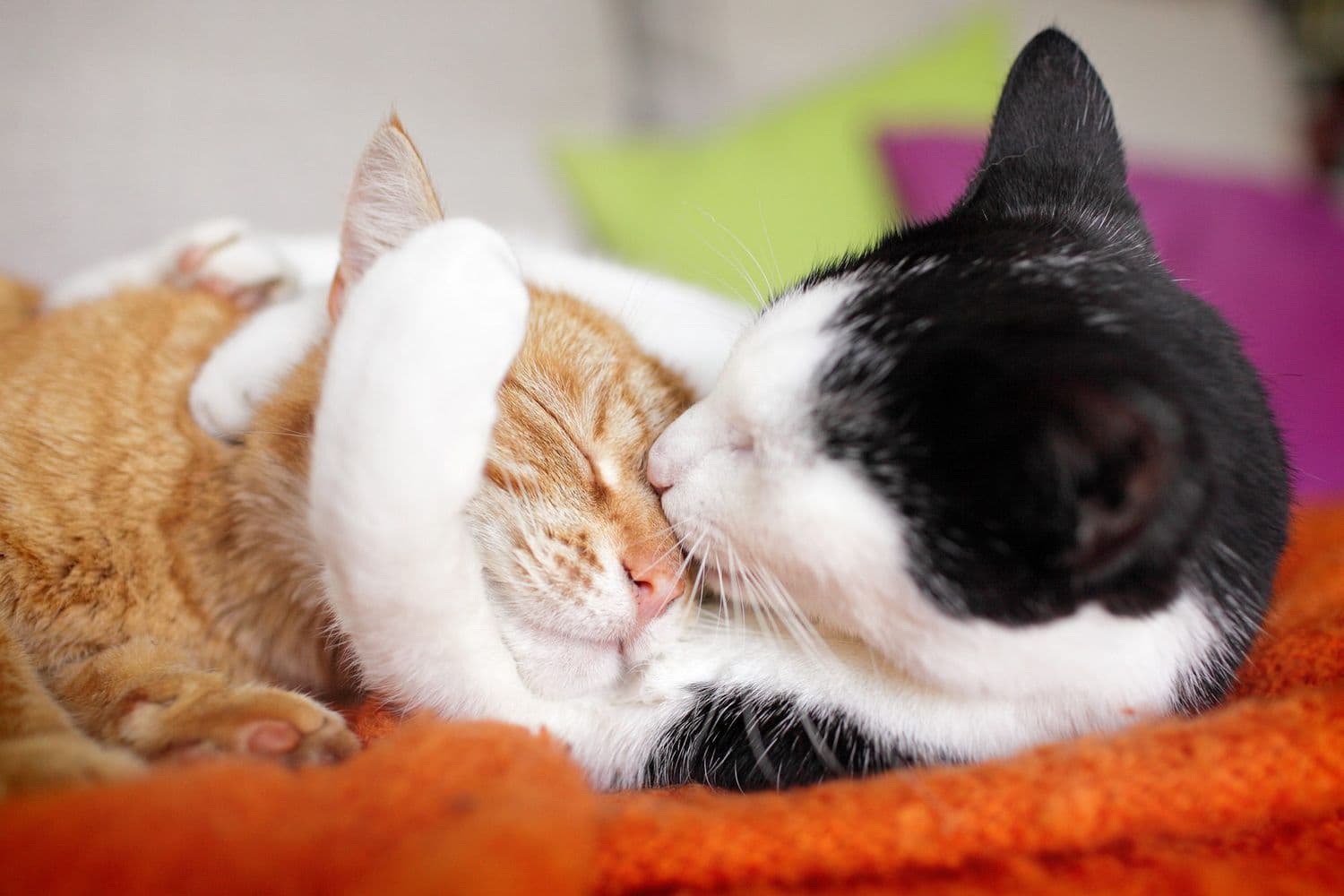
If you have ever loved a cat, you have probably wondered whether the feeling goes both ways. Your dog makes it obvious. They wag, they bounce, they stare at you like you are the center of the universe. Your cat sits on the other side of the room, blinks at you once, and yawns. Is that love? Or are you just the person who opens the food cans?
It is a fair question, and for a long time the answer most people gave was no. Cats were considered aloof, independent, and transactional. They tolerated humans in exchange for food and warmth, but they did not actually care about us. That view has been overturned over the past decade by a body of research on cat attachment, oxytocin, and feline cognition. The short answer is that yes, cats do feel something that functions like love. The longer answer is that it looks different from human love, and different from dog love, and the science of how we know is genuinely fascinating.
Let us walk through what the research says about cat attachment, the oxytocin evidence, the brain structures involved, how cats show affection, and why the question is harder to answer than it seems.
The 2019 attachment study that changed the conversation
The single most important study on this question was published in 2019 in the journal Current Biology, led by researcher Kristyn Vitale at Oregon State University. Vitale and her team ran what is called a secure base test, adapted from the Ainsworth Strange Situation test that has been used for decades to study attachment in human infants and dogs.
The setup works like this. A cat and their owner are together in an unfamiliar room. The owner leaves. A stranger enters. The stranger leaves. The owner returns. Researchers watch how the cat behaves at each stage, and specifically how they respond when the owner comes back. In attachment theory, a securely attached individual uses their caregiver as a base to explore from, and seeks comfort from them in a stressful situation. An insecurely attached individual either avoids the caregiver, or clings to them anxiously and resists exploration.
Vitale's team tested 79 kittens and their owners. The results were striking. About 65 percent of the cats showed secure attachment to their owners, meaning they explored the room comfortably when their owner was present, showed distress when the owner left, and returned to exploration once the owner came back. The other 35 percent showed insecure attachment styles, either avoidant or anxious. Those proportions are remarkably similar to what is found in human infants, where about 65 percent are securely attached. The study was the first to empirically demonstrate that cats form attachment bonds with their owners using the same framework used for children and dogs.
Oregon State University's press release on the study quoted Vitale directly: 'Like dogs, cats display social flexibility in their attachment to humans. The majority of cats are securely attached to their owner and use them as a source of security in a novel environment.' This was not a small finding. It directly contradicted the popular image of cats as solitary and indifferent, and it put cat attachment on the same scientific footing as dog and infant attachment.
The oxytocin evidence
Attachment behavior is one thing, but what about the underlying chemistry? In humans and dogs, the hormone oxytocin is closely associated with bonding, trust, and affection. It is sometimes called the 'love hormone,' though that is an oversimplification. The question is whether the same chemical system is at work in cats.
A 2024 study published in Scientific Reports investigated the effects of exogenous oxytocin on cat behavior toward humans. Researchers intranasally administered oxytocin to 30 cats and recorded their behavior. They found that oxytocin increased gaze duration toward humans, particularly in male cats. This is notable because a similar effect has been documented in dogs, where oxytocin increases mutual gaze between dog and owner, which in turn increases oxytocin in the owner, creating a positive feedback loop. The cat study suggests that the same oxytocin-mediated social bonding system is present in cats, though with some sex differences that differ from dogs.
A 2025 study published in the journal Applied Animal Behaviour Science went further, examining oxytocin secretion in cats with different attachment styles. Researchers recruited 30 pet cats, classified their attachment style using the secure base test, and then collected salivary oxytocin samples before and after free interaction with their owners. The results: oxytocin increased in securely attached cats after interacting with their owners, but tended to decrease in cats with anxious attachment. Securely attached cats also initiated more interactions, showed more approach behavior, and had fewer behavioral problems overall. This tells us that the attachment bond is not just behavioral, it has a measurable neurochemical signature. Cats who are securely bonded to their owners get an oxytocin response from interacting with them, the same way dogs and humans do.
The brain: same structures, same functions
Part of the reason it is reasonable to think cats feel something like love is that their brains are built from the same parts as ours. Cats have a limbic system, the set of brain structures that process emotion, and it includes the same key components as the human limbic system: the amygdala, the hippocampus, and related structures. The amygdala, which processes emotional relevance and generates responses like fear and pleasure, functions similarly in cats and humans.
This does not mean a cat's emotional experience is identical to a human's. Humans have a much more developed prefrontal cortex, which is involved in complex reasoning, self-reflection, and the conscious experience of emotion. When a human feels love, they are layering a conscious, narrative understanding on top of the underlying emotional response. A cat does not have that layer. What they have is the underlying response: the attachment, the comfort, the seeking of proximity, the distress at separation. Whether you call that 'love' or 'attachment' or 'bonding' is partly a philosophical question, but the biological machinery is there, and it produces behavior that looks an awful lot like love.
The counterargument: the 2015 Potter study
It is worth being honest about the fact that not every study has found the same thing. In 2015, a study by Potter and colleagues, published in the journal PLOS ONE, ran a version of the Ainsworth Strange Situation test with 20 cat-owner pairs and found no evidence consistent with secure attachment. They concluded that adult cats are typically quite autonomous, even in their social relationships, and not necessarily dependent on others to provide a sense of security.
So we have two studies using similar methods and reaching different conclusions. How do we reconcile that? The difference likely comes down to methodology and sample size. Vitale's 2019 study tested 79 cats, nearly four times the sample of the Potter study, and used a secure base test format that may have been better suited to measuring cat behavior. The Potter study itself noted methodological limitations in earlier cat attachment research and tried to address them, but their smaller sample and different procedural choices may have affected the results. The weight of the evidence, especially after the 2025 oxytocin study corroborated the attachment findings, leans toward cats forming genuine attachment bonds. But the Potter study is a reminder that this is an active area of research, not a settled question.
How cats show affection
If cats do feel something like love, the next question is how they show it. We covered some of this in the cat happiness article, but it is worth revisiting through the lens of attachment specifically. The signs of feline affection are real and observable, they just do not look like dog affection.
The slow blink. We covered the 2020 Sussex and Portsmouth study showing that cats slow-blink at their owners and approach more after a human slow-blinks. This is one of the clearest evidence-based affection signals cats have.
Bunting and headbutting. When a cat rubs their cheek or forehead against you, they are depositing pheromones from their scent glands and marking you as familiar and safe. It is a sign of trust and affiliation.
Kneading. This behavior originates in kittenhood as a way to stimulate milk flow, and adult cats do it when they feel safe and content. It is a comfort behavior tied to early feelings of security.
Following you around. A cat who follows you from room to room is not just hoping for food. They are seeking proximity, which is a core component of attachment behavior.
Sleeping on or near you. Cats are vulnerable when they sleep, so choosing to sleep on your lap or next to you is a sign that they trust you to keep them safe.
Exposing their belly. As we covered in the happiness article, this is a sign of trust, though not an invitation to touch it.
Vocalizing specifically at you. Cats rarely meow at other adult cats. The meow is a communication signal they developed for humans, and a cat who talks to you is directing social behavior at you specifically.
Do cats miss you when you are gone?
One of the strongest tests of whether an animal feels attachment is whether they show distress when the attachment figure disappears. For dogs, this is obvious. For cats, it has been harder to demonstrate, but the evidence does exist.
A 2017 study published in PLOS ONE investigated the effect of time left alone on cat behavior. Researchers found that cats and owners interacted more with each other after a longer duration of separation. The cats were more social, not less, after being alone for longer. This is consistent with attachment behavior, the cat is seeking reunion with the attachment figure after a period of absence.
Separation-related problems in cats are also documented, though they are less recognized than in dogs. A study published in the Journal of Feline Medicine and Surgery identified separation-related behavior in cats, including inappropriate urination, destructive behavior, excessive vocalization, and signs of distress when the owner was absent. A 2002 study by Schwartz found that in a sample of 136 cats diagnosed with separation anxiety, inappropriate urination had a prevalence of over 70 percent. These behaviors are not random. They are distress responses to the absence of a specific person, which is exactly what you would expect from an animal with an attachment bond.
Why the question is harder than it looks
Here is the honest part of this article. The question 'do cats feel love' is not just a scientific question. It is partly a philosophical one, and the answer depends on what you mean by love.
If by love you mean the conscious, narrative, self-reflective experience that humans have, where you think about the person, worry about them, plan a future with them, and feel a complex mix of emotion that you could write a poem about, then no, cats probably do not feel love in that way. They do not have the prefrontal cortex capacity for that kind of abstract, self-aware emotional experience.
If by love you mean a deep, persistent attachment to a specific individual, a desire for proximity, comfort from their presence, distress at their absence, a neurochemical reward from interacting with them, and behavior that prioritizes that individual over strangers, then yes, cats feel love. The 2019 Vitale study, the 2024 and 2025 oxytocin studies, the separation distress research, and the behavioral evidence all point in the same direction. Cats form bonds with their owners that are functionally equivalent to what we call love in other species, including humans. The bond is real. The chemistry is real. The behavior is real. It just does not come wrapped in a human-style conscious narrative.
There is also a tendency to frame this as a competition between cats and dogs, as if the fact that dogs show love more obviously means cats show it less. That is the wrong frame. Dogs and cats evolved different social structures. Dogs are descended from pack animals who relied on cooperative social bonds for survival. Cats are descended from solitary hunters who did not need a pack, but who did, through domestication, develop the capacity to bond with humans. The fact that cats can form attachments at all, given their evolutionary background, is arguably more remarkable than the fact that dogs do. Dogs were built for it. Cats developed it anyway.
The bottom line
Do cats feel love? The best answer the science can give is: yes, in the way that cats can, which is a real and measurable way. They form secure attachment bonds with their owners, using the same behavioral framework that human infants and dogs use. They get an oxytocin response from interacting with the people they are bonded to. They show distress when those people disappear. They seek them out when they return. They communicate with them using signals they do not use with other cats. The bond is not a human projection. It is a biological and behavioral reality.
Your cat is not writing poetry about you in their head. But they are, in a way that is measurable and documented, attached to you. When they sit on your lap and purr, when they slow-blink at you from across the room, when they meet you at the door after you have been gone, that is not indifference wearing a costume. It is a cat, doing the best a cat can do, to show you that you matter to them. And the science says that is enough to call it love.
Cat love FAQ
Do cats feel love for their owners?
Yes, in the way cats can. Research shows most cats form real attachment bonds with their owners: in a 2019 study led by Kristyn Vitale at Oregon State University, about 65 percent of the cats tested were securely attached. Cats also get an oxytocin response from interacting with owners they are bonded to and show distress when separated from them. What they probably lack is the conscious, self-reflective experience of love that humans have.
How can I tell if my cat loves me?
Common signs include slow-blinking at you, rubbing their cheek or forehead on you (bunting), kneading, following you from room to room, sleeping on or near you, showing their belly, and meowing at you, since adult cats rarely meow at each other.
Do cats get attached to their owners the way dogs do?
Yes. The secure base test used to study human infants and dogs found that most cats use their owner as a source of security, and the share of securely attached cats (about 65 percent) is similar to the share in human infants. Cats show it differently from dogs, but where dogs were built for bonding with people, cats developed the ability anyway.
Do cats miss their owners when they are gone?
The evidence says yes. A 2017 PLOS ONE study found that cats and owners interacted more after longer separations, and researchers have documented separation-related behavior in cats, such as inappropriate urination, destructive behavior and excessive vocalization.
Do all studies agree that cats form attachments?
No. A 2015 study by Potter and colleagues of 20 cat-owner pairs found no evidence of secure attachment. The 2019 study used a much larger sample and a 2025 oxytocin study supported its findings, so the weight of the evidence favors real bonds, but it remains an active area of research.
Keep reading
If you found this helpful, you might also like our guides on the signs of a happy cat, what purring really means and why your cat follows you around.
Further reading
Love learning about cats? Adopt a virtual cat pet and level it up by joining our community.
Related reading: Why Does My Cat Lick Me (and Then Bite Me)?.
Comments (0)
Join the conversation
Sign up to share your thoughts.
Loading comments...