What Do Cats Like to Play With and Why?
The science behind why your cat ignores the expensive toy and plays with the cardboard box instead

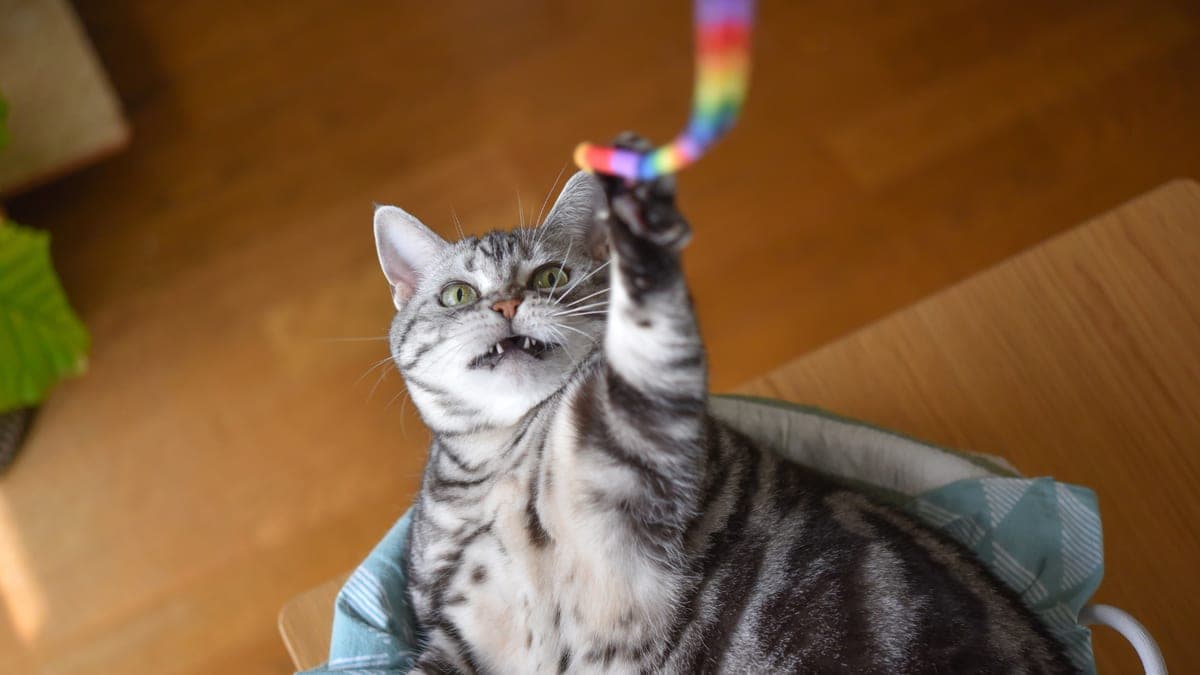
You spent thirty dollars on a feather wand. Your cat played with it for two minutes, lost interest, and spent the next hour batting a bottle cap around the kitchen floor. If you have ever stood in a pet store aisle staring at a wall of cat toys and wondering which one your cat will actually use, you are not alone. It is one of the most common frustrations of cat ownership, and it is also one of the most misunderstood.
The thing is, cats are not random about what they play with. They are actually incredibly specific, and their preferences are rooted in about ten million years of predatory evolution. When you understand what drives a cat to play, the bottle cap thing starts to make a lot more sense. And more importantly, you start to understand how to give your cat the kind of play that actually satisfies them instead of just wearing them out for five minutes.
This article is about what cats like to play with, why they like it, and how to use that knowledge to build a play routine that keeps your cat mentally and physically healthy. There is a lot of real research on this, and it turns out that play is one of the most important things you can get right as a cat owner.
All cat play is hunting practice
Let us start with the fundamental fact that explains everything else. When a domestic cat plays, it is almost always practicing hunting. Cats are obligate carnivores, meaning their bodies are designed to run on meat and nothing else. They come from a lineage of solitary, ambush-style hunters that emerged roughly eight to ten million years ago, and every aspect of their play behavior is connected to that ancestry.
A comprehensive review published in Applied Animal Behaviour Science categorized cat play into four types: social play (wrestling and chasing with other cats), locomotor play (running, jumping, the zoomies), object play (playing with toys and stuff on the floor), and predatory play (which overlaps with object play but specifically involves the hunting sequence). What is striking is how much all four types are connected to the same underlying drive. Even the zoomies, which look like pure chaos, are a cat practicing the explosive bursts of speed they would use to chase down prey.
This is why cats are picky about toys in ways that might seem arbitrary. They are not looking for entertainment in the human sense. They are looking for something that triggers their predatory sequence, which is a deeply ingrained set of behaviors: search, stalk, chase, pounce, grab, kill. A toy that does not trigger that sequence is, to a cat, just an object. A toy that does trigger it is the most exciting thing in the room.
Size, texture, and movement: what makes a toy interesting
Researchers have actually studied what makes a cat respond to a toy, and the answers are surprisingly specific. In a series of experiments conducted by Sarah Hall and John Bradshaw at the University of Southampton, cats were presented with toys of different sizes covered in fake fur and moved back and forth in a forty-five-degree vertical arc. The cats consistently preferred smaller toys, roughly the size of a mouse, over larger ones. They also responded more to toys that had a furry or complex texture compared to smooth ones.
A follow-up study published in Applied Animal Behaviour Science looked at habituation, meaning how quickly cats get bored of a toy. The researchers found that cats lose interest in a toy rapidly, often within a few minutes, if the toy's sensory characteristics do not change. But when they swapped the toy for one of a contrasting color, the cats suddenly played with it intensely again. This suggests that the motivation to play had not actually disappeared during the boring phase. The cats still wanted to play. They just needed something new to look at.
This is the single most important thing to understand about cat toys. Cats do not get tired of playing. They get tired of the same toy. The drive is still there. The object just needs to feel fresh. This is why rotation works so well, and why a cat who has ignored a toy for weeks will suddenly go crazy for it if you put it away and bring it back out a month later. It is also why your cat loses interest in the expensive wand toy after two minutes but will play with a new bottle cap for twenty. The bottle cap is novel. The wand toy is the same thing they saw yesterday.
So the three key predictors of whether a cat will play with something are size, texture, and novelty. Small is better than large. Furry or textured is better than smooth. And new is always better than familiar. Movement matters too. Cats are extraordinarily sensitive to motion, more than to shape or color. A toy that moves in an erratic, unpredictable way, like a mouse darting for cover, will almost always trigger a stronger response than a toy that moves in a straight line or sits still.
Prey preference: not every cat wants the same toy
Here is something that explains a lot of confusion in multi-cat households. Cats have individual prey preferences. Research published in Applied Animal Behaviour Science found that domestic cats specialize in different types of prey. Some cats are rodent hunters. Some are bird hunters. Some are insect hunters. And some are generalists who will go after whatever is available.
This carries over directly to toys. If your cat goes nuts for feather wands and things that chirp or flutter in the air, their prey preference is probably birds. If they prefer mouse-shaped toys, balls that bounce, and crinkly things that make high-pitched sounds, they are probably a rodent hunter. If they love chasing laser dots or jumping after wiggly fabric on the end of a string, they might be an insect hunter.
This matters because if you buy the wrong type of toy, your cat may simply not care, and it is not because they do not like playing. It is because you are offering them the wrong kind of prey. A bird-hunting cat may ignore every mouse toy you bring home. A rodent-hunting cat may watch a feather wand with total disinterest. The best way to figure out your cat's preference is to try a variety of toy types and watch what they respond to. Once you know, you can focus your toy budget on the things that actually trigger their hunting sequence.
If you have multiple cats, do not be surprised if they have completely different preferences. This is normal. It is not a sign that one cat is picky and the other is easygoing. They are just wired for different prey.
The hunting sequence and why it matters
International Cat Care, one of the most respected feline welfare organizations, describes the hunting sequence as a set of distinct stages: searching the environment, locating prey, stalking, chasing, pouncing, grabbing, and delivering a kill bite. In the wild, a cat might cycle through this sequence multiple times on a single prey item, letting it go and recatching it, batting it to see if it still moves, and repeating until the prey is dead.
This sequence is the key to understanding why some play sessions leave your cat satisfied and others leave them frustrated. A good play session lets the cat go through the whole sequence. A bad one lets them do part of it but not all of it. And the part that most people skip is the ending, the catch and the kill.
Preventive Vet, a veterinary education organization, recommends structuring play sessions to mirror the full prey sequence. You start by making the toy move like prey, hiding behind furniture, darting out, pausing. This triggers the search, stalk, and chase. Then you let the cat pounce and actually catch the toy. Then you let them bite it, bunny-kick it, and hold it in their mouth for a few seconds. This is the kill. Finally, you feed the cat. This completes what behaviorists call the hunt-catch-kill-eat cycle, and it is the most satisfying sequence a cat can experience.
If you skip the catch and the kill, the cat is left with pent-up predatory energy and no release. This is the root cause of a lot of what gets labeled as play aggression. The cat chased and stalked but never got to finish the job, so they are still in hunting mode, and your ankles become the next target. Giving the cat something to actually catch at the end of the session is not optional. It is the point.
The laser pointer problem
Laser pointers are one of the most popular cat toys in the world, and they are also one of the most controversial among behaviorists. The reason is simple. A laser dot is impossible to catch. The cat can chase it, stalk it, and pounce on it, but they can never grab it or kill it. The hunting sequence is permanently incomplete.
A study published in the journal Animals in 2021 looked at this directly. Researchers surveyed over six hundred cat owners about their use of laser pointers and found a significant association between the frequency of laser play and the occurrence of abnormal repetitive behaviors in cats. These behaviors included chasing lights or shadows, staring obsessively at lights or reflections, and fixating on specific toys. The more frequently owners used laser pointers, the more likely they were to report these behaviors. The study was correlational, not causal, but the pattern was clear and consistent across all the behaviors surveyed except overgrooming.
The researchers noted that over half of owners were aware that laser pointers could frustrate cats if the cat never got to catch something, but only about a third actually did anything about it. The recommendation from behaviorists is not that you should never use a laser pointer. It is that you should always end the session by directing the cat to something physical they can actually catch. Move the laser toward a toy mouse or a treat, let the cat pounce on that, and let them complete the kill sequence. The laser is the chase. The toy or treat is the catch. You need both.
If your cat seems frustrated, agitated, or more bitey after laser play, this is probably why. They are not being difficult. They are a predator who just spent ten minutes chasing something they could never catch, and their brain is telling them the hunt is not over. Give them something to kill.
Wand toys and interactive play
Wand toys, the kind with a stick and a string and something dangling on the end, are generally considered the gold standard for interactive cat play by behaviorists and veterinarians. They let you simulate prey movement in a way that no self-play toy can match. You can make the lure hide behind a chair, dart across the floor, fly through the air, and go limp. You can adjust the speed and pattern to match your cat's prey preference, whether that is a bird fluttering, a mouse running, or a bug zigzagging.
The key to using a wand toy well is to make it act like real prey. Real prey does not move in a straight line at a constant speed. It hides, it freezes, it bolts, it changes direction, it plays dead, and then it suddenly runs again. If you just drag the toy in a circle, your cat will get bored. If you make it behave like something that is trying to survive, your cat will stay engaged for much longer.
Ingrid Johnson, a certified cat behavior consultant at Fundamentally Feline in Atlanta, makes a point that surprises a lot of owners. Cats often love simple homemade toys as much as or more than commercial ones. A crumpled ball of paper, a bottle cap, a cardboard box, a paper bag. These things are novel, they have interesting textures and sounds, and they do not cost anything. The pet industry has convinced people that cats need elaborate toys, but the cat's brain is responding to size, texture, movement, and novelty, not to price tags or brand names.
One important safety note. Wand toys should never be left out when you are not supervising. Cats can chew off and swallow the string, which can cause a life-threatening intestinal blockage. Put them away after every session. This also has the side benefit of keeping the toy novel, since the cat only sees it during play time.
Food puzzles and puzzle feeders
Food puzzles, also called puzzle feeders or foraging toys, are a different category of play that is gaining a lot of attention in the veterinary behavior world. The idea is simple. Instead of putting food in a bowl, you put it in a device that the cat has to manipulate to get out. This could be a ball with holes that kibble falls out of when rolled, a mat with fabric strips the cat has to paw through, or a tube the cat has to reach into.
Food puzzles work because they tap into the searching and foraging part of the hunting sequence. In the wild, a cat does not just walk up to a bowl and eat. It has to find prey, figure out where it is hiding, and work to catch it. A food puzzle recreates that cognitive challenge. Studies on environmental enrichment in captive animals, including cats in shelters, have shown that foraging enrichment reduces stress, decreases destructive behavior, and increases overall activity levels.
A review published in the Journal of Feline Medicine and Surgery by the AAFP and ISFM recommended food puzzles as a standard part of feline environmental enrichment. They noted that food puzzles are particularly valuable for indoor cats, who do not have the opportunity to hunt and who can become understimulated in a home where food is always available in the same spot. If your cat seems bored, food puzzles are one of the cheapest and most effective things you can try.
You do not have to buy anything to start. A muffin tin with a little food in each cup, covered by tennis balls the cat has to knock out, is a perfectly good beginner puzzle. An empty toilet paper roll with the ends folded in and holes poked in the sides is another one. The point is not the device. It is the challenge.
Catnip, silver vine, and olfactory enrichment
Catnip is the most famous cat enrichment product in the world, and it works by triggering a response to specific plant compounds called iridoids. Not every cat responds to catnip, though. The sensitivity is genetic, and roughly thirty percent of cats do not react to it at all. Kittens under about six months and older cats also tend to be less responsive.
Silver vine, also known as matatabi, is a plant from East Asia that triggers a similar response and may actually be more effective than catnip. A study published in BMC Veterinary Research tested cats' responses to silver vine, catnip, Tatarian honeysuckle, and valerian root, and found that silver vine elicited the strongest response in the most cats. A more recent study published in Scientific Reports in 2022 confirmed that silver vine is safe for cats and identified the specific iridoid compounds responsible for the response. Interestingly, cats that do not respond to catnip often do respond to silver vine, which makes it a good alternative if your cat is in the non-responder group.
A 2025 study in Applied Animal Behaviour Science looked at whether adding a cat's preferred scent, either catnip or silver vine, to toys would increase play. The results were interesting. Adding the scent to stationary toys did increase interaction. But adding it to moving toys did not make a difference, because the cats were already playing with the moving toys at a high level. In other words, scent enrichment helps with toys that do not move on their own, but movement is the stronger trigger when it is available.
The practical takeaway is that catnip and silver vine can make old toys interesting again. If your cat has stopped playing with a particular toy, rubbing some catnip or silver vine powder on it can reset the novelty. It is not a replacement for interactive play, but it is a useful tool for self-play enrichment, especially when you are not home.
How much play does a cat actually need?
This is the question that ties everything together, because even the best toy in the world is useless if the cat does not get enough play time. The consensus among veterinarians and behaviorists is that cats need about thirty minutes of structured play per day, ideally broken into two or three sessions of ten to fifteen minutes each. Kittens and young cats under two years old may need more, and they may need more frequent, shorter sessions because their attention spans are shorter.
PetMD and the American Animal Hospital Association both recommend this baseline. The reason it matters is that under-stimulated cats are the ones who develop behavior problems. Play aggression, where the cat attacks hands and feet, is almost always a result of insufficient predatory outlet. Destructive behavior, excessive vocalization, and nighttime activity can also stem from a cat who has energy and nothing to do with it. VCA Animal Hospitals specifically notes that play-related aggression is driven by unused energy and a lack of appropriate play opportunities.
The structure of the session matters as much as the length. A good session starts with active, fast-paced play to get the cat in hunting mode, gradually slows down as the prey tires, and ends with the cat catching the toy and getting a small snack. This mirrors the natural hunt-catch-kill-eat-groom-sleep cycle, and it is why a well-structured play session often ends with the cat settling down for a nap. They have completed the sequence, and their body responds the way it would after a real hunt.
If you can only do one thing differently after reading this article, make it this. Get a wand toy, spend fifteen minutes a day playing with your cat in a way that lets them go through the full hunting sequence, and end with something they can catch. That one change will do more for your cat's happiness and behavior than any toy you can buy.
Toy rotation: the free trick that doubles play time
Remember the habituation research from earlier? Cats get bored of the same toy, but they do not get bored of playing. The practical application of this is toy rotation, and it is the single most effective free thing you can do to increase your cat's play without spending another dollar.
The approach recommended by VCA Animal Hospitals is to keep a stash of about twenty toys but only put out four or five at a time. Rotate them weekly. When you swap the toys out, the old ones feel new again because the cat has not seen them in a while. This keeps novelty high without requiring you to constantly buy new toys. It also lets you test which types your cat responds to, because you can watch which toys get used and which get ignored.
This is also the answer to the bottle cap mystery. A bottle cap is novel. It appeared on the floor out of nowhere, it has a new texture, it makes a new sound, and it moves in an unpredictable way when batted. The thirty-dollar wand toy that has been sitting in the corner for a week is the opposite of novel. Your cat is not being ungrateful. They are responding exactly the way their brain is wired to respond. Give them the wand toy fresh out of a drawer they have not seen it in for a month, and they will probably go just as crazy for it as they did for the bottle cap.
Toys to avoid
A quick word on safety, because some of the most popular cat toys are also the most dangerous. String, yarn, ribbon, and dental floss are extremely hazardous if swallowed. They can cause linear foreign bodies, which is a veterinary emergency where the string bunches up the intestines and can slice through the intestinal wall. Any toy with string should be put away after supervised play. This includes wand toys, which is why behaviorists consistently recommend storing them out of reach between sessions.
Small parts that can be swallowed are another risk. Feather wands that shed small feathers, toys with glued-on eyes or noses, and anything with bells or plastic pieces that can be chewed off should be inspected regularly. If a toy is falling apart, throw it away. It is not worth the risk.
Finally, do not use your hands or feet as toys. It is tempting when a kitten is tiny and their bites do not hurt, but you are training them that human body parts are prey. When they grow up and their jaws are stronger, this becomes a real problem. Play aggression toward hands is one of the most common behavioral complaints cat owners bring to vets and behaviorists, and it almost always traces back to being allowed to play with hands as a kitten. Use a toy. Always.
Putting it all together
If you take one thing from this article, let it be this. Your cat's play preferences are not random. They are the output of ten million years of hunting instinct filtered through an individual personality. When your cat ignores an expensive toy and plays with a piece of trash, it is not because they are being difficult. It is because the trash is the right size, has a novel texture, makes an interesting sound, and moves unpredictably. The expensive toy is probably too big, too familiar, and too static.
The best play routine for a cat is simple and does not require a lot of money. Get a wand toy and use it for ten to fifteen minutes a day, making it move like real prey. Let your cat catch it at the end. Rotate toys weekly so novelty stays high. Try food puzzles for mental stimulation. Figure out your cat's prey preference and buy toys that match it. Use catnip or silver vine to refresh old toys. And never, ever use your hands as toys.
Do that, and your cat will be calmer, more settled, and less likely to attack your ankles at midnight. Not because they are tired, but because their brain has been allowed to do the thing it was built to do. Cats are hunters. Play is how they hunt when there is nothing to hunt. Give them a good hunt, and they will be the content, relaxed companion you wanted when you brought them home.
Keep reading
If you found this helpful, you might also like our guides on why cats get the zoomies, how play signals happiness and when play turns to meowing.
Further reading
Love learning about cats? Adopt a virtual cat pet and level it up by joining our community.
Related reading: Why Do Cats Bring You Dead Animals? What It Really Means.
Comments (0)
Join the conversation
Sign up to share your thoughts.
Loading comments...